
This story was first published in digitalhealth.net

New concept designs unveiled for two new Leeds hospitals
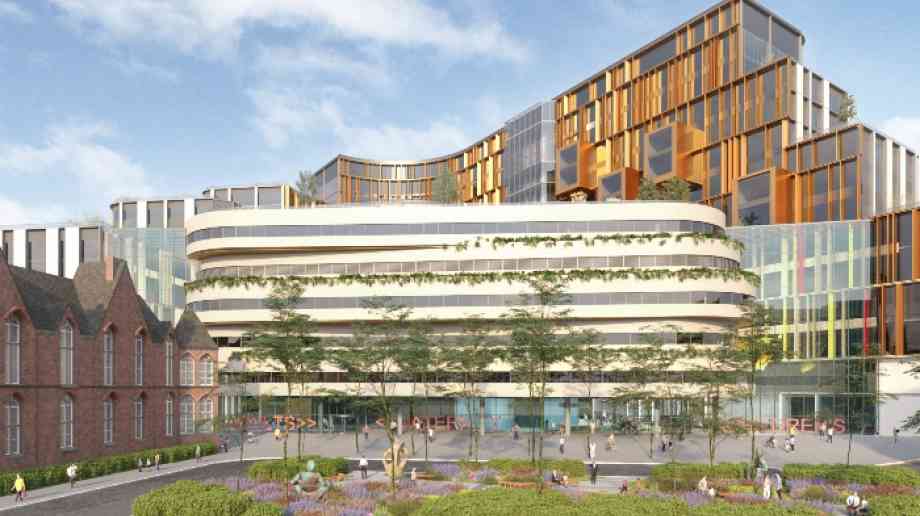
Two new state-of-the-art hospitals for Leeds came a step closer today with the unveiling of the latest concept designs of the new buildings – inspired by the Yorkshire landscape.
The major interdisciplinary practice, BDP, has been appointed by Leeds Teaching Hospitals NHS Trust to lead the architectural design of its Hospitals of the Future programme, part of its long-term vision to transform healthcare facilities for patients and staff in Leeds and the wider region.
The new first design concepts take the new hospital development to the next stage but will still need detailed design development and will be used as the basis for further engagement over the next 12-18 months as the final design is agreed for the two new hospitals at Leeds General Infirmary. BDP has proposed a hospital structure that is shaped like the contours of the Yorkshire fells and dales, with a large island garden and play deck at its centre. Outdoor space and play areas were some of the facilities that children and young patients suggested in a design competition, held last year, which have inspired the architects with their latest concept.
The development of a new adults’ hospital, along with a new home for Leeds Children’s Hospital, is set to be one of the most significant healthcare projects in the UK.
For the first time in Leeds, a brand-new Leeds Children’s Hospital will bring all clinical services for children and young people under one roof. The new hospital will enable LCH to expand and meet the demand for highly specialised services in areas including cancer treatment, neurology, liver, kidney and bone marrow transplantation and congenital heart surgery.
Julian Hartley, chief executive of Leeds Teaching Hospitals NHS Trust, said: “The building of our two new hospitals is the most important development in Leeds city centre for a generation. And, in terms of hospital-based healthcare, it’s the most important development in the city centre since 1868, when Leeds General Infirmary was first built.
“It’s wonderful to see that BDP has listened to the feedback we’ve given them and have come up with these concept designs that are thoroughly patient focussed, and which place patient and staff wellbeing at the heart of our new hospitals. These concept designs give extensive access to daylight and greenery, and not only do they maximise wellness, but they also bring something of the dales into the city centre. These inspirational designs will see not only the creation of world class medical and research facilities, but also the creation of a landmark public building, of real architectural quality, of which Leeds can truly be proud.”
The trust is planning to commence construction in 2023, enabling us to align with the government’s New Hospital Programme and benefit from the collaborative approach of working at scale, allowing us to share our experience with other less developed schemes, in areas such as digital technology, sustainability and modern methods of construction.
By working in this collaborative way we will maximise the benefits and efficiencies, ensure delivery of state-of-the-art healthcare facilities for local patients and staff, whilst also representing value for money for the taxpayer. The Hospitals of the Future project is part of the government’s commitment to build 40 hospitals by 2030, backed by an initial £3.7 billion.
Dame Linda Pollard, chair of Leeds Teaching Hospitals NHS Trust, said: “We’re very proud of the progress we have made with the plans for our new hospitals, and we’re excited by the concepts put forward for what will be the most important development in Leeds city centre for many years.
“Digital technology and world-leading innovative techniques will be central to the services provided in the new hospitals whilst the old hospital estate will be redeveloped as part of the City’s Innovation District, bringing about direct and wider economic benefits of up to £11.2 billion in net present value terms and more than 3,000 jobs. This redevelopment of the old LGI site will also help us to preserve some beautiful buildings with significant history to their former glory.”
Latest News

16/02/2024 - 12:56
Hammersmith and Fulham Council has created a new alliance intended to clean dirty air and improve residents' health.

16/02/2024 - 10:44
Two million more GP appointments a month are being delivered for patients compared to the same month before the pandemic as part of the NHS primary care access recovery plan according to new NHS data.

15/02/2024 - 10:26
The Welsh Government has provided innovation funding of £380,000 to support two projects utilising technology in domiciliary care.

15/02/2024 - 10:13
The new Scottish health secretary has met with frontline staff at Queen Elizabeth University Hospital in Glasgow.

14/02/2024 - 10:27
The North East London NHS Foundation Trust (NELFT) has appointed three new Executive Directors to the Trust Board.
Product Features

UK Building Regulations highlight toxic gas and smoke from layers of paint built up over multiple redecorations as a major cause of permanent ill health or death in a building fire.
Their concern rose with discovery the flame retardant paints most widely used paint along escape routes have been ones which to this day counter-productively use emission of heavy toxic gas to smother flames which rapidly spread along walls if layers of paint delaminate in a fire.
Supplier Profiles

Northwich’s Victoria Infirmary (VIN) Community Diagnostic Centre (CDC) has enabled more patients

Adveco, the commercial hot water specialist, announces the launch of live metering of domestic ho
Latest Features

Sarah Greenslade, public affairs and communications officer at the British Parking Association looks at some of the problems and innovations in healthcare parking

It’s easy to assume that the comms team is there to handle press enquiries and the occasional social media storm – but the reality is that strategic communications can make a measurable impact across the entire organisation, from operational to financial, when done properly


