
This story was first published in digitalhealth.net

Space technology could help long-stay hospital patients
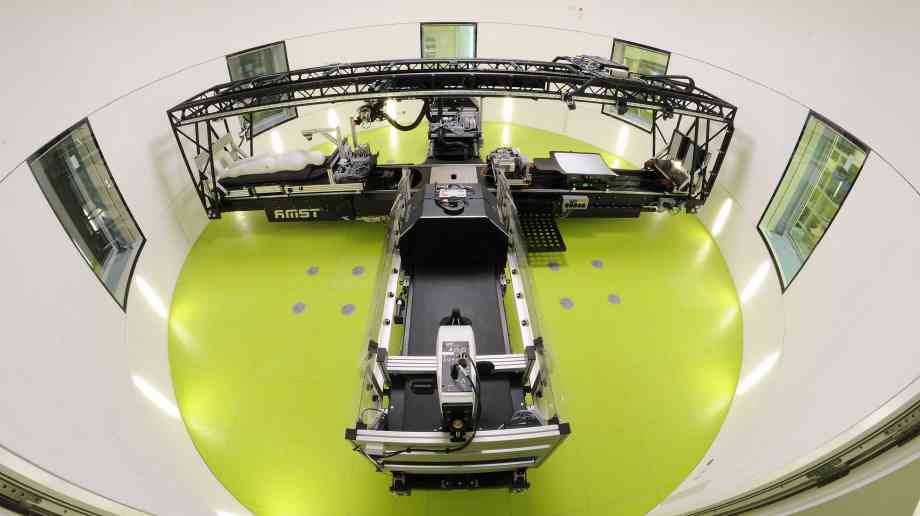
Scientists are learning how to tackle muscle wasting in astronauts who experience zero gravity in space, which can also be used to help patients who develop muscle weakness from lengthy stays in a hospital bed, or those suffering from lower back pain.
The new research projects at Manchester Metropolitan University and Northumbria University are being supported by the UK Space Agency, ESA, NASA and the German Aerospace Centre (DLR).
The project at Manchester Metropolitan University is led by Professor Hans Degens’ team from the research centre for Musculoskeletal Science and Sports Medicine.
The team will perform a series of medical tests on volunteers subjected to 60 days of bed-rest, which mimics the microgravity conditions of space travel. But some will also spend 30 minutes each day strapped into the human centrifuge, where they lay flat as it spins, simulating the force of gravity experienced when standing on Earth.
Professor Hans Degens said: "Artificial gravity could help astronauts to maintain muscle mass in space and help back here on Earth too by preventing severe muscle degeneration in hospitalised patients.
"Currently astronauts have to exercise for up to two and a half hours every day, take nutrient supplements, and keep high protein diets to maintain muscle mass while they are in space. Despite this, severe muscle deterioration still occurs.
"One day, astronauts might have a daily quick spin in a centrifuge on the ISS rather than spend hours on gym equipment in space. For hospital patients it could greatly improve their recovery during rehabilitation and after they leave."
The team from Northumbria University’s Aerospace Medicine and Rehabilitation Laboratory, led by Professor Nick Caplan, is interested in spinal postural deconditioning, an issue linked to lower back pain and age-related problems with balance.
The study will use the human centrifuge to explore the effectiveness of daily exposure to artificial gravity in preventing spinal problems from developing. It will also test the effectiveness of a rehabilitation device – which resembles a customised gym cross trainer and is known as the Functional Re-adaptive Exercise Device (FRED) – in the early weeks following the 60 day bed rest period.
Professor Nick Caplan said: "The bedrest study is providing an ideal platform for us to determine how suitable our device is for use in the rehabilitation of astronauts when they have spent time aboard the International Space Station in microgravity.
"We will be using advanced neurophysiological and medical imaging techniques to understand how the spinal postural muscles adapt to simulated microgravity and determine the effectiveness of a rehabilitation programme designed for use not just in astronauts, but also in populations on Earth, such as people with low back pain or those with postural instability."
Latest News

16/02/2024 - 12:56
Hammersmith and Fulham Council has created a new alliance intended to clean dirty air and improve residents' health.

16/02/2024 - 10:44
Two million more GP appointments a month are being delivered for patients compared to the same month before the pandemic as part of the NHS primary care access recovery plan according to new NHS data.

15/02/2024 - 10:26
The Welsh Government has provided innovation funding of £380,000 to support two projects utilising technology in domiciliary care.

15/02/2024 - 10:13
The new Scottish health secretary has met with frontline staff at Queen Elizabeth University Hospital in Glasgow.

14/02/2024 - 10:27
The North East London NHS Foundation Trust (NELFT) has appointed three new Executive Directors to the Trust Board.
Product Features

UK Building Regulations highlight toxic gas and smoke from layers of paint built up over multiple redecorations as a major cause of permanent ill health or death in a building fire.
Their concern rose with discovery the flame retardant paints most widely used paint along escape routes have been ones which to this day counter-productively use emission of heavy toxic gas to smother flames which rapidly spread along walls if layers of paint delaminate in a fire.
Supplier Profiles

Northwich’s Victoria Infirmary (VIN) Community Diagnostic Centre (CDC) has enabled more patients

Adveco, the commercial hot water specialist, announces the launch of live metering of domestic ho
Latest Features

Sarah Greenslade, public affairs and communications officer at the British Parking Association looks at some of the problems and innovations in healthcare parking

It’s easy to assume that the comms team is there to handle press enquiries and the occasional social media storm – but the reality is that strategic communications can make a measurable impact across the entire organisation, from operational to financial, when done properly


