
This story was first published in digitalhealth.net

Castle Hill Hospital site meets power needs with Solar Array
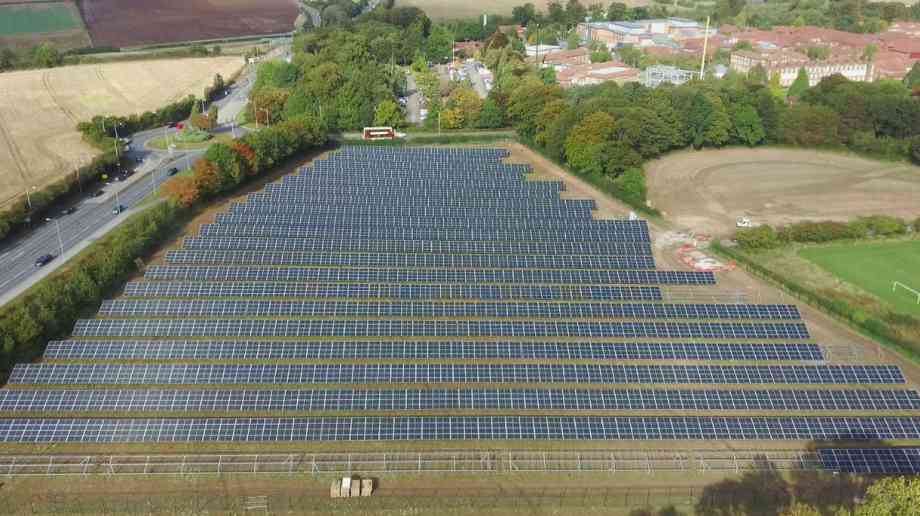
Castle Hill Hospital in Yorkshire is now completely powered by its own solar energy.
Hull University Teaching Hospitals NHS Trust began installing solar panels on land adjacent to the Hospital site in September 2021.
The project, known as the ‘Field of Dreams’, saw 11,000 panels installed at a cost of £4.2m. Work was completed in February.
The arrival of British Summer Time means the panels are now generating enough electricity to meet the complete daytime power needs of the entire Castle Hill site.
Alex Best, Head of Capital for the Trust says:
“Back in November 2020 we were lucky enough to receive a grant from the Department for Business Energy and Industrial Strategy as part of its Public Sector Decarbonisation Scheme to enable us to embark on this ambitious solar panel installation project.
“Our aim has always been to generate enough electricity to make the hospital site self-sufficient in the summer months when the days are longer, and now that the clocks have gone forward, the panels are generating around 26MWh per day so far in May, and are anticipated to rise to a peak summer load of 50 MWh per day*.
“Not only does this represent a significant contribution towards our plan to become carbon neutral by 2030, but the project is also saving us a significant amount of money on hospital energy bills; approximately £250,000 to 300,000 every month.
Marc Beaumont, Head of Sustainability for the Trust says:
“Castle Hill Hospital is a specialist regional centre for cardiology, oncology and haematology for example, and it boasts one of just a handful of specialist infectious diseases units around the country. When you consider the size of the Castle Hill Hospital site and the amount of activity that goes on here, that’s a huge amount of power that’s required to keep it running.
“Now if you stop to consider what the solar panel project is actually contributing, it’s incredible to think that the power used to deliver patients’ radiotherapy treatment sessions, to support many life-saving surgical procedures, and to keep our intensive care unit running right now is all completely self-generated, green electricity.”
Latest News

16/02/2024 - 12:56
Hammersmith and Fulham Council has created a new alliance intended to clean dirty air and improve residents' health.

16/02/2024 - 10:44
Two million more GP appointments a month are being delivered for patients compared to the same month before the pandemic as part of the NHS primary care access recovery plan according to new NHS data.

15/02/2024 - 10:26
The Welsh Government has provided innovation funding of £380,000 to support two projects utilising technology in domiciliary care.

15/02/2024 - 10:13
The new Scottish health secretary has met with frontline staff at Queen Elizabeth University Hospital in Glasgow.

14/02/2024 - 10:27
The North East London NHS Foundation Trust (NELFT) has appointed three new Executive Directors to the Trust Board.
Product Features

UK Building Regulations highlight toxic gas and smoke from layers of paint built up over multiple redecorations as a major cause of permanent ill health or death in a building fire.
Their concern rose with discovery the flame retardant paints most widely used paint along escape routes have been ones which to this day counter-productively use emission of heavy toxic gas to smother flames which rapidly spread along walls if layers of paint delaminate in a fire.
Supplier Profiles

Northwich’s Victoria Infirmary (VIN) Community Diagnostic Centre (CDC) has enabled more patients

Adveco, the commercial hot water specialist, announces the launch of live metering of domestic ho
Latest Features

Sarah Greenslade, public affairs and communications officer at the British Parking Association looks at some of the problems and innovations in healthcare parking

It’s easy to assume that the comms team is there to handle press enquiries and the occasional social media storm – but the reality is that strategic communications can make a measurable impact across the entire organisation, from operational to financial, when done properly


